Workers arrive on-site tired, distracted, or rushing to meet deadlines. They skip a PPE check. They bypass a lockout tag. Someone trips over unsecured cabling. These aren’t “accidents waiting to happen”—they’re symptoms of weak safety culture. And the most effective antidote isn’t a 50-page manual or a yearly seminar. It’s the daily, five-minute conversation: the toolbox talk.
Toolbox talks are short, focused safety meetings held at the start of a shift or before a high-risk task. When done right, they reinforce protocols, surface hazards, and build team accountability. When done poorly—scripted, rote, or irrelevant—they’re ignored. The difference is content and delivery. Below are real, field-tested health and safety toolbox talks examples that work across industries—from construction to manufacturing to utilities.
Why Most Toolbox Talks Fail (And How to Fix It)
Many teams treat toolbox talks as compliance checkboxes. A supervisor reads from a template, workers nod, signatures are collected. No discussion. No engagement. No follow-up.
Common failures include: - Generic content not tied to current tasks - One-way delivery without worker input - Repetitive topics with no variation - No link between talk and site conditions
Fix: Make talks specific, interactive, and actionable. Use real-time hazards as triggers. For example, if you see frayed cords near a work area, run a talk on electrical safety—right then, not next Tuesday.
5 High-Impact Toolbox Talk Examples
#### 1. Working at Height – Harness Inspection & Anchor Points
Scenario: Crew preparing to work on a rooftop.
Key Points: - Inspect harness for cuts, frayed webbing, damaged buckles - Confirm anchor point rating (5,000 lbs minimum) - Use 100% tie-off when edges are within 6 feet - Never tie off to unstable structures (e.g., conduit, railings not rated)
Discussion Prompt: “What would you do if your harness failed during a fall? Have you ever found damage during a pre-use check?”
Action: Have each worker demonstrate harness inspection on their own gear. Document findings.
#### 2. Hand Tool Safety – Beyond the Basics
Scenario: Maintenance team using grinders, saws, and impact wrenches.
Key Points: - Check for damaged cords, loose guards, or cracked housings - Use PPE: safety glasses, gloves, hearing protection - Never carry tools by the cord or hose - Store tools properly after use
Real Mistake: A worker used a grinder without the guard. Spark contact caused a minor eye injury. The guard would have deflected debris.
Checklist (for workers): - ✅ Inspected tool before use - ✅ Guard in place and secure - ✅ PPE worn - ✅ Work area clear of tripping hazards
#### 3. Confined Space Entry – Communication & Rescue
Scenario: Crew entering a sump pit for cleaning.

Key Points: - Permit required? Is gas testing done? - Attendant must remain outside, monitor conditions - Communication method: rope signals, radios, hand signals - Rescue plan in place—practice it monthly
Discussion Prompt: “If the worker inside loses comms, what’s the first thing the attendant does?”
Tip: Run a 2-minute drill: simulate comms failure and walk through emergency steps.
#### 4. Slips, Trips, and Falls – Housekeeping Matters
Scenario: General site cleanup after a storm.
Key Points: - Wet surfaces = immediate hazard. Use signs, barriers, absorbent - Cables across walkways? Elevate or reroute - Debris buildup in high-traffic zones increases risk - Report spills immediately
Real Example: A worker slipped on an oil patch near a generator. No signage. Minor sprain, but reportable.
Action: Assign 5 minutes at shift end for area sweep. Rotate responsibility weekly.
#### 5. Heat Stress Awareness – Recognizing the Signs
Scenario: Summer work, prolonged outdoor tasks.
Key Points: - Symptoms: dizziness, nausea, headache, excessive sweating then dry skin - Hydration: drink water every 15–20 minutes, even if not thirsty - Rest breaks: 10 minutes every hour in shaded/cool area - Buddy system: monitor each other
Discussion Prompt: “Have you ever felt overheated on the job? What helped?”
Tip: Use a wet bulb globe temperature (WBGT) meter if available. When WBGT >80°F, increase monitoring.
Industry-Specific Toolbox Talk Adaptations
One-size-fits-all talks don’t work. Tailor content to your environment.
| Industry | Common Hazard | Talk Focus |
|---|---|---|
| Construction | Falling objects | Hard hat use, toe boards, exclusion zones |
| Manufacturing | Machine guarding | Lockout/tagout, emergency stops |
| Utilities | Overhead power lines | Safe distances, spotter use, signage |
| Warehousing | Forklift traffic | Pedestrian paths, horn use, blind spots |
| Telecom | Ladder stability | 3-point contact, 4:1 ratio, surface check |
Adapting the talk shows workers you see their reality—not just reciting policy.
How to Deliver a Toolbox Talk That Sticks
A good toolbox talk isn’t delivered—it’s facilitated. Use this framework:
- Hook (1 min): Start with a near-miss, incident, or hazard observed that morning.
- “I saw a ladder leaning on a gutter this morning. That’s unstable—let’s talk why.”
- Explain (2 min): Cover the hazard, rules, and risks. Use visuals if possible—photos work better than slides.
- Engage (2 min): Ask open questions. Get 2–3 workers to respond.
- “What’s one time you corrected someone’s ladder setup?”
- Act (1 min): Assign a micro-action: inspect equipment, report an issue, review a procedure.
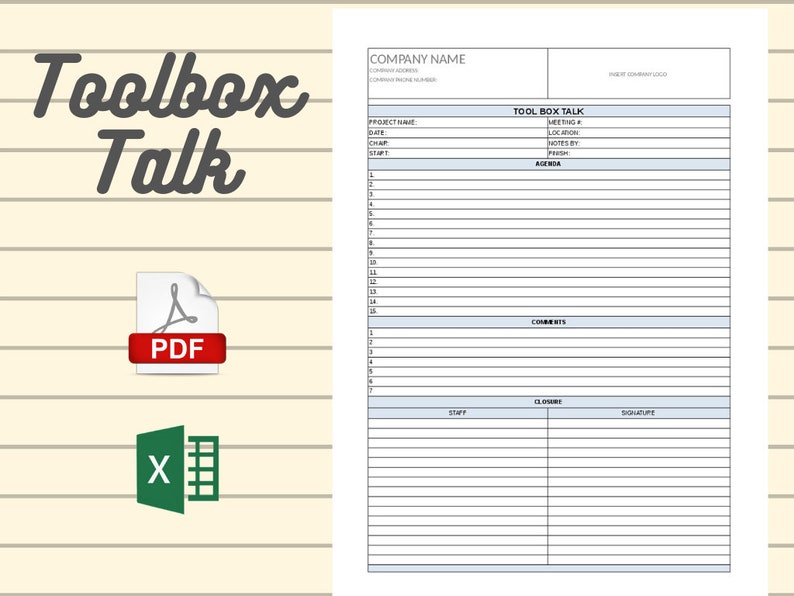
- Document: Sign-in sheet with topic, attendees, date. Not for compliance theater—use it to track recurring issues.
Avoid reading verbatim. Know the topic. Make eye contact. Rotate facilitators—experienced workers often deliver the most credible talks.
Common Mistakes to Avoid

- Repetition without variation: Talking about PPE every Monday gets old. Mix topics or dive deeper: “Today, not just wearing gloves—knowing which glove for chemical vs. cut resistance.”
- Ignoring worker feedback: If someone raises a real concern (“the eyewash station is blocked”), act on it. Or you lose trust.
- Wrong timing: Don’t hold talks when workers are clocking out or mid-task. Hold them pre-shift or pre-task.
- No follow-up: Did you talk about ladder safety? Walk the site later and acknowledge compliance—or correct issues.
- Too long: Keep it under 10 minutes. Respect their time.
Bonus: 5 Free Toolbox Talk Resources
Need templates or inspiration? These are vetted, practical, and widely used:
- OSHA.gov Toolbox Talks
- - Official, plain-language guides
- - Covers 30+ topics, printable PDFs
- - Best for: Regulatory alignment
- NIOSH Safe Lifting Guide + Talk Sheet
- - Science-backed ergonomics
- - Visuals for proper lifting techniques
- - Best for: Warehousing, healthcare
- Construction Safety Council (CSC) Talks
- - Industry-specific, with discussion questions
- - Includes bilingual (English/Spanish) versions
- - Best for: Multilingual crews
- Energy Safe Victoria (Australia) Mini Safety Talks
- - Real incident case studies
- - Short, scenario-based formats
- - Best for: Electrical, utility work
- SafetyOneToolbox.com (Free Section)
- - User-submitted talks with photos
- - Covers niche topics like drone safety, solar panel work
- - Best for: Innovation and real-world relevance
Use these as starting points—but customize. Add your site photos, near-misses, and local rules.
Make It a Habit, Not a Chore
The best safety cultures don’t rely on one “big talk” a month. They talk safety daily. A toolbox talk should feel natural—like checking the weather before a drive.
Start small. Pick one high-risk area. Run focused, 7-minute talks weekly. Rotate facilitators. Track participation and hazards raised. Review monthly: Are incidents decreasing? Are workers speaking up?
When a worker stops a job because a harness looks frayed, or reminds a colleague to test air in a confined space—that’s the talk working. Not the signature on the sheet. The behavior change.
Use these health and safety toolbox talks examples as blueprints. Adapt them. Own them. Make safety part of the daily rhythm, not an interruption to it.
FAQ
What is a typical duration for a toolbox talk? Most effective talks last 5 to 10 minutes—long enough to cover the hazard, short enough to hold attention.
Who should lead a toolbox talk? Supervisors typically lead, but experienced workers can and should facilitate to build ownership and credibility.
How often should toolbox talks be held? At minimum, weekly. High-risk sites or tasks may require daily talks, especially before non-routine work.
Should toolbox talks be documented? Yes—record the topic, date, attendees, and any actions. Use logs to track trends, not just for audits.
Can toolbox talks reduce workplace incidents? Yes—when they’re relevant, interactive, and tied to real hazards. Studies show sites with consistent talks see 20–30% fewer recordables.
Are toolbox talks only for construction? No. Manufacturing, utilities, healthcare, and logistics teams use them effectively to address site-specific risks.
What makes a toolbox talk engaging? Real examples, open questions, visual aids, and direct links to the day’s work. Avoid reading scripts.
FAQ
What should you look for in Health and Safety Toolbox Talks Examples That Actually Work? Focus on relevance, practical value, and how well the solution matches real user intent.
Is Health and Safety Toolbox Talks Examples That Actually Work suitable for beginners? That depends on the workflow, but a clear step-by-step approach usually makes it easier to start.
How do you compare options around Health and Safety Toolbox Talks Examples That Actually Work? Compare features, trust signals, limitations, pricing, and ease of implementation.
What mistakes should you avoid? Avoid generic choices, weak validation, and decisions based only on marketing claims.
What is the next best step? Shortlist the most relevant options, validate them quickly, and refine from real-world results.